
Top#10 reasons most entrepreneurs fail in Vietnam: some risks can be covered, the rest is 'Vietnam business as usual'
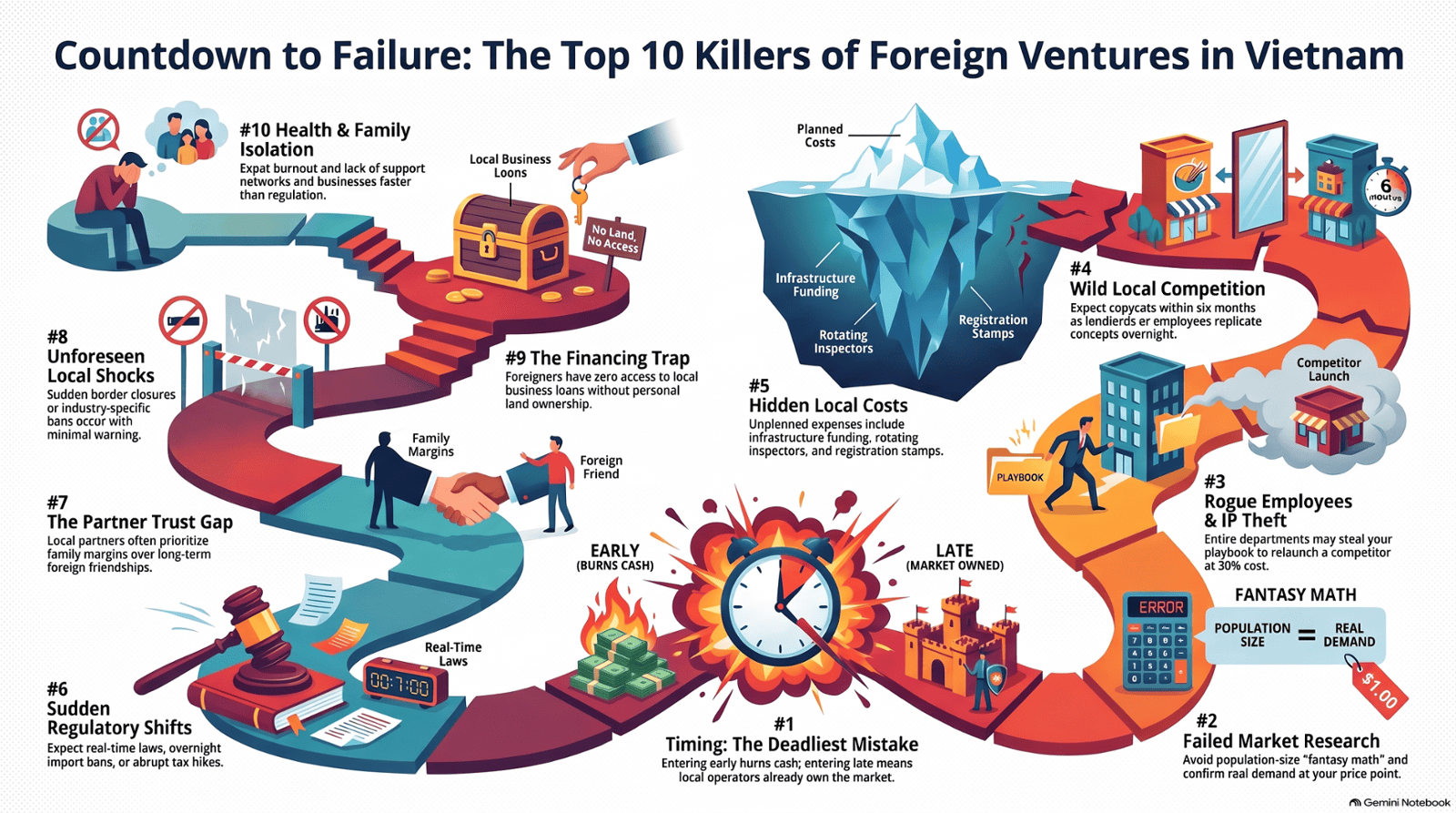
Why Foreign Businesses Fail in Vietnam, and How to Avoid the Ten Blind Spots
Foreign entrepreneurs often arrive with solid budgets and great ideas, then close far sooner than expected. It is rarely the obvious risks that do it. These ten risks are acute and specific to doing business in Vietnam, and many can be reduced at low cost with the right advice, early.
The short answer
Mostly because of ten recurring blind spots, not the failures founders plan for: timing, thin market research, rogue employees, fast local copycats, hidden costs, sudden regulation, misjudged local partners, external shocks, no access to local credit, and health or family strain. Experience is unavoidable, but you do not have to buy all of it with your own capital. Consulting long-established peers, a resident lawyer and an insurance broker before and during launch addresses many of these cheaply.
The countdown: 10 reasons foreign ventures fail in Vietnam
Each risk below is paired with the low-cost step that tends to help most. Insurance covers only some of them; the others are managed through advice, contracts and research.
Health and family issues
Isolation and homesickness can strain expat families, and a sudden health emergency without medical evacuation cover can freeze operations overnight.
Lack of funds and financing
Without local real estate to pledge as collateral, foreign founders have little access to local bank loans, so unexpected working capital drains can be fatal.
Unforeseen global and local shocks
Policy updates, border restrictions or tax shifts can arrive with little warning in Vietnam's independent regulatory landscape.
Misunderstanding "Vietnamese partners"
Local partners, landlords and contractors may not treat relationships as Western counterparts do. Trust is earned slowly and verified continuously.
Sudden new rules and regulations
Frameworks are written in real time: caps on foreign headcount, import restrictions and new licensing hurdles can appear unexpectedly.
Local hidden and unexpected costs
Unbudgeted ministry registrations, inspection visits, duties and local infrastructure requirements catch many foreign owners off guard.
Wild local competition
Local operators adapt fast, and a proven concept can face aggressive copycats within six months of demonstrating demand.
Rogue employees
Key staff or whole teams can leave with playbooks and client lists to launch cheaper rivals, and local labor courts typically favor employees.
Failed or non-existent market research
Copy-pasting Western models or assuming "if just 1% buy, we'll be rich" fails when consumers lack interest or willingness to pay your price.
Timing: too early or too late
Too early drains your runway waiting for the market; too late means entrenched local operators with capital and land have already won.
Experience is a must. Paying full price for it is not.
Gathering experience in Vietnam is unavoidable, but a few hours with the right people can spare you the costliest lessons. Three conversations to have before committing capital:
Long-established peers
Owners who have operated in Vietnam for many years know the real costs, the partner pitfalls and the timing of your market.
A resident lawyer
For licensing, foreign ownership rules, labor contracts and partner agreements that hold up locally.
An independent insurance broker
To separate insurable risks (health, evacuation, property, liability) from those that need other solutions, and to place cover at fair terms.
Frequently asked questions
Why do foreign businesses fail in Vietnam?
Rarely for the obvious reasons. Experienced operators point to ten recurring blind spots, from poor timing and weak market research to rogue employees, sudden regulation and health emergencies.
Can these risks be reduced cheaply?
Many can. Speaking with established peers, a resident lawyer and an insurance broker before committing capital costs little compared with the losses it can prevent.
Which of these risks can insurance address?
Mainly medical and evacuation costs, and certain property, liability and business-interruption losses. Regulation, competition and market fit are not insured and are managed through legal advice, peer input and research. A broker can tell you which is which.
Can a foreign founder get a local bank loan in Vietnam?
It is typically very difficult without local real estate to pledge as collateral, so plan working capital carefully from day one.
Who is InsuranceinAsia?
An independent medical and non-life insurance brokerage active in Vietnam and ASEAN since 1994, advising expats, internationally mobile professionals and businesses.
Don't learn these lessons the expensive way
Read the full post for the complete breakdown and practical risk-mitigation strategies, or speak with an independent broker about what is worth insuring in your Vietnam venture.
Email Advice@InsuranceinAsia.comRequest a risk review