
The many reasons Foreigners can not retire in Vietnam... yet.
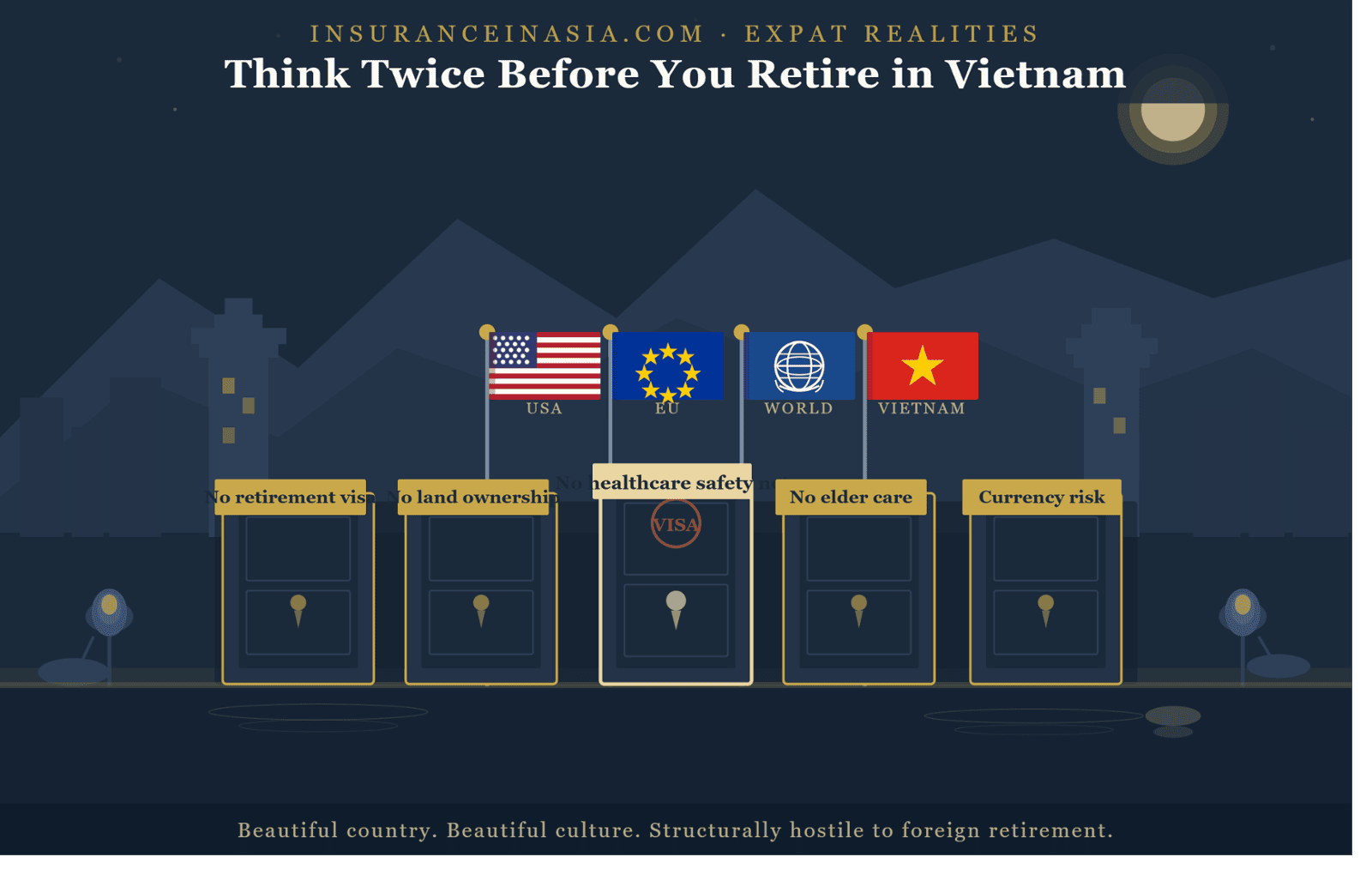
As of 2026, Vietnam has no official retirement visa. Foreigners cannot qualify for long-term residency based on age or pension income alone. The closest alternatives — investor visas, business visas, and 90-day e-visas — all require ongoing administrative effort and significant capital.
You've been here on holiday a few times. The food is extraordinary, the cost of living feels like a miracle after London or Sydney, and everyone seems friendly. I completely understand the impulse. I felt it too, thirty years ago. Retirement is a different proposition entirely.
Let me walk you through, systematically, why Vietnam — for all its genuine appeal — remains structurally hostile to foreign retirees. Not hostile in a personal sense; the Vietnamese people are warm and welcoming. Hostile in a legal, administrative, medical, and financial sense. These are not minor inconveniences. They are structural barriers that the government has, so far, shown little urgency to dismantle.
Long-Read · Retirement Planning
Think Twice Before You Retire in Vietnam.
A Frank Word from Someone Who Stayed.
Vietnam is seductive. I know — I came, I stayed, I built a life here. But "staying" and "retiring" are two very different things, and when a friend recently told me he was planning to retire here, I felt obliged to have a long, honest conversation. This is that conversation, in writing.
You've been here on holiday a few times. The food is extraordinary, the cost of living feels like a miracle after London or Sydney, and everyone seems friendly. I completely understand the impulse. I felt it too, thirty years ago. But I was in my thirties, I had income, I had energy for paperwork, and I didn't need a hip replacement. Retirement is a different proposition entirely.
Let me walk you through, systematically, why Vietnam — for all its genuine appeal — remains structurally hostile to foreign retirees. Not hostile in a personal sense; the Vietnamese people are warm and welcoming. Hostile in a legal, administrative, medical, and financial sense. These are not minor inconveniences. They are structural barriers that the government has, so far, shown little urgency to dismantle.
"Vietnam works brilliantly for active expats with income and tolerance for bureaucracy. It remains stubbornly ill-suited for what retirement actually requires: security, stability, and the quiet confidence that your arrangements won't unravel when you're 75."
The Ten Hard Truths
Why Retiring in Vietnam Is Practically Impossible for a Foreigner
There Is No Retirement Visa. Full Stop.
This is where every other problem begins. As of 2026, Vietnam has no official retirement visa — unlike Thailand, the Philippines, Malaysia, or Indonesia, all of which offer dedicated long-stay programmes for retirees with passive income. Vietnam has nothing equivalent. You will not find a visa category at any embassy that says "retirement." What you will find are workarounds, each of which comes with its own set of costs, conditions, and expiry dates. You are, legally speaking, never a retiree here. You are always something else — a tourist, a businessman, an investor — pretending.
The Visa Alternatives Are Exhausting and Expensive
Your realistic options are: a 90-day e-visa requiring you to physically leave the country every three months; an investor visa (ĐT1) requiring a minimum capital injection of VND 3 billion — roughly $120,000 USD — for a one-year validity; a business visa requiring you to set up and maintain a company; or a spousal visa if you happen to be married to a Vietnamese national. None of these were designed for retirees. All of them require ongoing administrative engagement, professional help, and recurring cost. This is not the visa situation of someone sitting peacefully on a veranda in Da Nang. This is the visa situation of someone who must perpetually justify their presence in the country.
You Will Never Own the Ground Beneath Your Feet
All land in Vietnam belongs to the state. Foreigners cannot own land under any circumstances — the Land Law 2024 makes this unambiguous. What you can do is acquire a 50-year leasehold on an apartment unit in approved residential buildings, capped at 30% foreign ownership per building. You cannot get a mortgage from a Vietnamese bank. You will buy in cash, or not at all. And when you eventually want to sell, your buyer pool is restricted. If the quota is full, you can only sell to Vietnamese citizens — which will compress your exit price. A 50-year leasehold bought at age 65 expires when you're 115. In theory, fine. In practice, the renewal terms, resale constraints, and absence of freehold security are a significant source of legal and financial risk for anyone planning to anchor their retirement to Vietnamese property.
The Business Route Is a Trap for the Unwary
Many retirees use the business visa route — setting up a small company to get a work permit and residency. I've watched this play out badly more times than I care to count. Vietnam's corporate environment is complex, the culture around "facilitation" is real, and as a foreigner without language and deep local networks, you are exposed. People have invested in premises or businesses and been pushed out. Partners have proven unreliable. Legal recourse, when disputes arise, is slow and expensive. Setting up a business just to stay in the country is the wrong tool for the wrong problem, and it generates ongoing obligations — accounting, tax filings, statutory requirements — that are the opposite of a peaceful retirement.
Life & Accident Cover for Expatriates in Vietnam
No employer. No group scheme. No safety net — unless you build one yourself.
Portable term life and personal accident plans from $30/month, placed independently across ASEAN since 1994.
Healthcare Is Good — Until You Really Need It
I want to be fair here. The private hospitals in Hanoi and Ho Chi Minh City — Vinmec, FV, Raffles, the French Hospital — are genuinely good facilities with English-speaking staff and competent physicians. For routine care, diagnostics, and standard procedures, you will be well served. But healthcare quality drops sharply outside major cities, and the public system is underfunded and largely inaccessible to non-Vietnamese speakers. More importantly: as you age, your needs will escalate. Complex oncology. Neurology. Advanced cardiac work. Specialised rehabilitation. These require either repatriation — which is costly, disruptive, and emotionally brutal — or a level of private coverage with no realistic annual cap. International health insurance for a retiree in their 70s in Vietnam can run to $3,000–$6,000 a year or more. Budget for it from day one.
Elder Care Is Essentially Non-Existent for Foreigners
This is the conversation nobody wants to have in advance, and the one that matters most. What happens if you develop dementia? If you need full-time nursing care? If you can no longer manage your own affairs? Vietnam's private elder care sector is nascent. The few quality facilities that exist are expensive relative to average incomes — and health insurance does not cover long-term residential care. At very high dependency levels — advanced dementia, complex nursing requirements — you may simply find that adequate provision does not exist in Vietnam, and that medical repatriation to your home country is your only dignified option. Plan for that from the start, because repatriation at that stage of life, without prior planning, is an emergency rather than a transition.
Air Pollution Is a Serious, Chronic Health Risk
Hanoi routinely ranks among the most polluted cities in Southeast Asia. Ho Chi Minh City is not far behind, particularly in dry season when traffic and construction combine into a persistent particulate haze. For retirees — statistically more likely to have cardiovascular and respiratory vulnerabilities — this is not an aesthetic inconvenience. It is a genuine, measurable health risk. If you have any history of asthma, COPD, heart disease, or respiratory sensitivity, the air quality in Vietnam's major cities should be a material factor in your decision, not a footnote.
The Administrative Burden Never Goes Away
Banking for foreigners without a work permit is difficult. Receiving pension income from abroad involves transfer fees, currency risk, and the occasional bureaucratic wall. Leases require renewal. Visas require renewal — or exit and re-entry. Utility connections, insurance, property management, dealing with building management committees: all of these require either fluency in Vietnamese, a reliable local fixer (who costs money and may not always be trustworthy), or willingness to spend significant time on administration. In retirement, you imagined reading books and taking walks. What Vietnam may actually give you is an ongoing second job managing your own legal existence here.
The Language Barrier Is Steeper Than You Think
Vietnamese is a tonal language with six tones in the southern dialect. It shares no root with any European language, and the written form — Romanised since the 17th century, which is a mercy — gives no indication of the pronunciation challenges that await. Most retirees never get beyond survival phrases. This is fine in Saigon's expat enclaves. It becomes genuinely limiting in medical situations, legal contexts, interactions with government offices, and day-to-day life outside the international bubble. Dependency on translators and intermediaries in your most vulnerable moments — health emergencies, legal disputes, bureaucratic crises — is a real and underappreciated risk.
Your Pension and Financial Arrangements Weren't Designed for This
The Vietnamese đồng is not freely convertible and can fluctuate. Transferring pension income internationally incurs ongoing costs. UK expats need to consider SIPP, QROPS, or QNUPS structures. US citizens abroad remain subject to IRS filing obligations regardless of where they live. Double taxation treaty positions with Vietnam are not always straightforward. The financial architecture of a comfortable retirement — pension access, investment income, estate planning, inheritance — was built around the assumption that you'd be resident in a country with a predictable legal framework and robust financial infrastructure. Vietnam is improving, but it is not there yet.
Regional Context
How Vietnam Compares to Its Neighbours
Before you commit, it's worth knowing what other Southeast Asian countries offer retirees. The contrast is stark.
| Country | Retirement Visa | Property Freehold | Mortgage for Foreigners | English in Healthcare | Elder Care Infrastructure |
|---|---|---|---|---|---|
| Vietnam | ✗ None | ✗ Leasehold only (50yr) | ✗ Effectively no | ◐ Private cities only | ✗ Very limited |
| Thailand | ✓ Non-OA / Non-OX | ✗ Condo leasehold (30yr) | ✗ Rare | ✓ Widely available | ◐ Developing |
| Philippines | ✓ SRRV (Special Retire) | ◐ Condo ownership OK | ✗ Limited | ✓ English-speaking nation | ◐ Moderate |
| Malaysia | ✓ MM2H programme | ✓ Freehold permitted | ◐ Some options | ✓ Widely available | ✓ Well-developed |
| Indonesia | ◐ KITAS (limited) | ✗ No freehold | ✗ No | ◐ Major cities only | ✗ Very limited |
On every structural metric that matters for long-term retirement security, Vietnam sits at or near the bottom of this peer group. That is not a reason never to come. It is a very good reason to plan differently.
Senior Lifetime Healthcare — Coverage That Travels With You
Designed for retirees aged 55–75 living across ASEAN. No annual renewal shock. No geographic restriction. Guaranteed renewable for life, with inpatient limits up to $1.5M. The plan your Vietnamese doctor can actually bill.
My Recommendation
What I'd Actually Tell You to Do
Here's the honest version of what I say to friends who call me from abroad with this plan. Vietnam can be part of your retirement. It probably shouldn't be the whole of it — at least not until the government creates a proper legal framework for foreign retirees, which may still be years away.
- Base yourself legally in a country with a proper retirement visa — Thailand, Malaysia, or the Philippines. Keep that as your formal legal domicile. Come to Vietnam on extended stays.
- If you want Vietnam as your primary base, make sure you have significant capital (the investor visa route at $125,000 minimum), a Vietnamese-speaking lawyer on retainer, and a plan for what happens if your health deteriorates significantly. Write that plan down before you arrive.
- Sort your health coverage before you land — not after. At 60+, a comprehensive international health insurance plan with high annual limits and no geographic restrictions is non-negotiable. Budget $3,000–$6,000 per year depending on age and coverage. This is not optional.
- Rent for at least two years before considering any property purchase. The market is improving but quota restrictions, leasehold-only structures, and the absence of mortgage finance mean that a property decision here is irreversible in ways it wouldn't be at home.
- Keep your financial ties to your home country intact. Maintain a bank account there. Keep your pension payments landing somewhere with a stable currency and banking infrastructure. Vietnam can be where you spend your money; it shouldn't necessarily be where you hold it.
- Build an exit plan into your arrival plan. Know, concretely, what happens if you need to leave — temporarily or permanently. Who manages your affairs here? Who has your power of attorney? Where do you go for complex medical care? These are questions for year one, not year ten.
Vietnam rewards the flexible, the resourceful, and the well-prepared. It punishes the assumption that it works like retirement in France or Australia. Come with open eyes, the right legal structure, and comprehensive insurance — and it can be an extraordinary chapter. Come assuming it will all sort itself out, and it won't.
Planning an extended stay or retirement base in Vietnam? InsuranceinAsia has been placing international health, life, and non-life coverage for expatriates across ASEAN since 1994. We'll find you a policy that actually covers what Vietnam can't.
Get Independent Advice →A Note on Sources
The structural barriers documented in this article are based on current Vietnamese law — principally the Housing Law 2023, the Land Law 2024 (effective January 2025), and immigration regulations as of mid-2026 — as well as reporting from specialist expat and legal sources listed below. Laws change. Always verify current visa and property regulations with a qualified Vietnamese lawyer before making any commitment.
Sources & References
For readers interested in official and reliable sources, you can email us at advice@insuranceinAsia.com — most will be Vietnam laws sites by the relevant ministry or specialised immigration services or lawyers updated on the latest feasibilities. No influencers.