
Iran War & Insurance related questions Feb-28, 2026

11.03.26 08:41 AM

Guide to Insurance refund in times of the Iran War
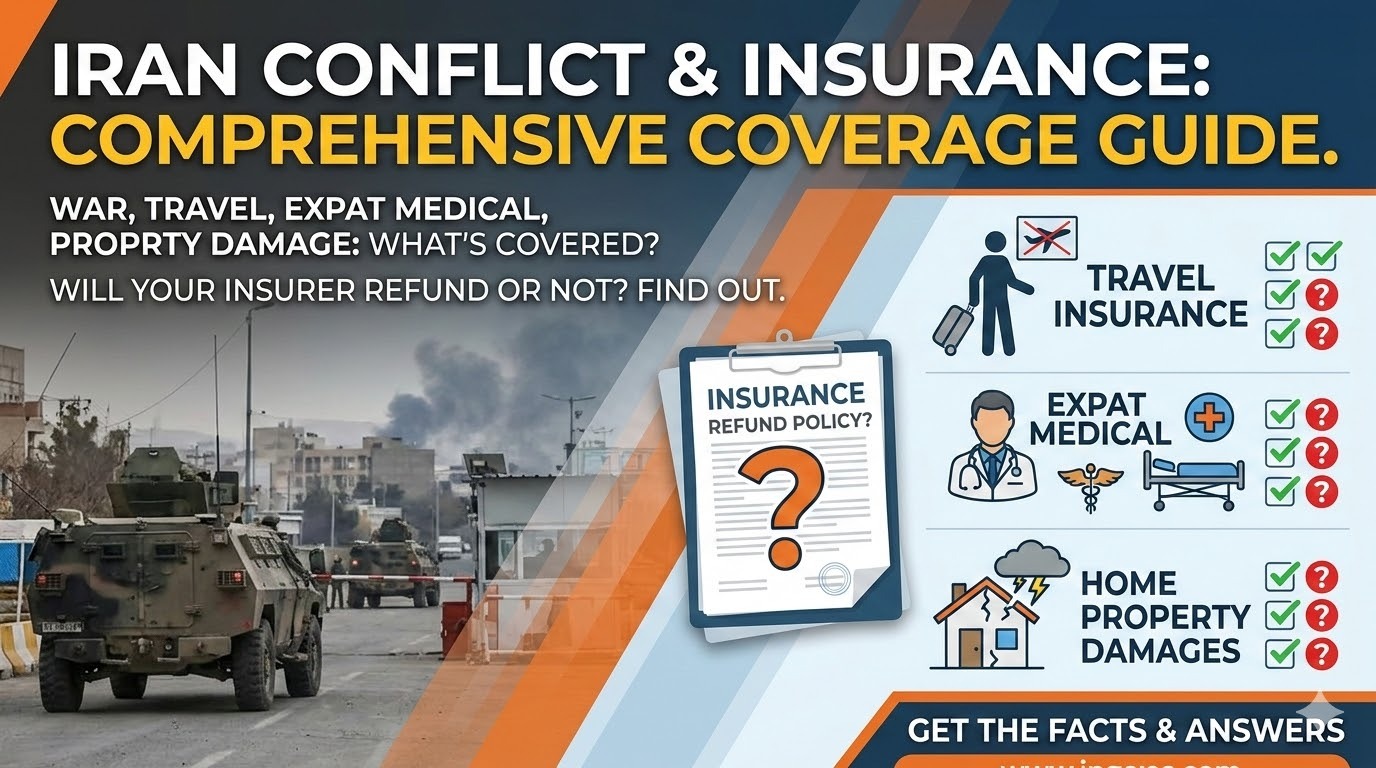
Below is a structured overview of the 15 most common questions expats, travelers, digital nomads, and remote workers ask insurers or brokers when a war escalates in the Middle East (e.g., Iran-related conflict). These questions typically arise immediately after travel advisories, airspace closures, sanctions, or military escalation.

I grouped them into 3 categories relevant to insurance coverage:

  • 🏥 Health / Injury / Death

  • ✈️ Travel Disruption

  • 🏠 Property / Liability

I also include the countries of residency where these questions most often originate, based on typical expatriate flows and insurer claim inquiries.

Answers to Top 15 Insurance questions asked during Iran War

As of 28-Mars 2026, the escalation of conflict between Israel and Iran has triggered a surge in inquiries from the expat and digital nomad communities in the Middle East. With airspace closures across the GCC (UAE, Qatar, Kuwait, Bahrain, Saudi Arabia) and the Levant (Jordan, Lebanon), insurance companies have shifted to "Known Event" protocols.

Below are the top 15 questions currently being asked by residents and travelers, categorized by their primary concern.

I grouped them into 3 categories relevant to insurance coverage: Health & Life - Travel disruptions - Property & belongings
Medical, Death & Life Insurance payments

1. If I am injured by a missile strike while in my apartment in Dubai, is my medical treatment covered?

  • Context: Expats in the UAE and Qatar. Expats working in Gulf countries
  • The Reality:Standard IPMI (International Private Medical Insurance) often excludes "active participation" in war but may cover "passive war risk" (collateral damage) for civilians, by-standers are covered. Now if FDCO list excludes the country and “Known Fact” is applied -you know but you still go-, you will be considered as willing to travel/work in a "Do Not Travel" zone and not covered.

  • 2. If sanctions prevent insurers from paying claims involving Iran, will my claim be rejected?

  • Context:Expats with global insurers
  • The Reality: Claims payment embargo on currency has nothing to do with eligibility of your claim. Just nominate another bank account to receive your refund

  • 3. Does my life insurance pay out if I die in a cross-border drone attack?

  • Context: Expats in Israel and Jordan. Long term expats
  • The Reality: Most term life policies cover civilian deaths in war zones, unlike travel insurance which often has strict "War and Terrorism" exclusions for accidental death.

  • 4. If my employer’s insurance doesn’t cover war zones, can I buy special coverage?

  • Context: NGO workers / contractors 
  • The Reality: Not personally, but your employer may buy or already has insurance for that, like journalists, video reporters or the red cross doctors.

  • 5. Will my insurance pay for an emergency medical evacuation if local hospitals are overwhelmed by casualties?

  • Context: Remote workers in Lebanon and Jordan.Corporate expats. Tourists and short-term travelers
  • The Reality: This is a major gray area. If the evacuation is due to a medical condition unrelated to war (e.g., appendicitis) but hospitals are full due to conflict, it may be covered. Direct war-zone evacuations usually require a "War Risk" rider. The difficulty is to get a medevac plane!

  • 6. If I voluntarily travel to a war zone after advisories are issued, will any coverage apply?

  • Context: Journalists, contractors
  • The Reality: Yes, ask your sponsor employer. The CNN reporters got escorted by The Iranian army

  • 7. If my company relocates me from the Middle East, will the insurance still cover me in the new country?

  • Context: Corporate Expats
  • The Reality: Yes, just ask your broker to change your new address and area of cover zone 2 on you Insurance certificate

  • 8. I can't get my heart medication because of supply chain disruptions; will my insurer ship it to me?

  • Context: Long-term expats in Bahrain and Saudi Arabia
  • The Reality: Yes, insurers are increasingly handling these as "assistance cases," though the cost of armored or secure transport may be excluded. Yes if some courier services can land

  • 9. Is my 'War and Terrorism' rider still valid now that a 'State of War' has been officially declared?

  • Context: Inquiries from UK and Australian expats living in the region.
  • The Reality: Yes, many riders have a 7-to-14-day cancellation clause once a conflict reaches a certain intensity. You purchased it before “Known event” for that possible occurrence. You would typically get a refund 50-to-100% of your insured values instead of zero. Check by a professional broker

  • 10. If my embassy orders evacuation, will my travel insurance reimburse the emergency flight?

  • Context: Tourists and short-term travelers 
  • The Reality: Your government will pay. Any shortfall, your insurance will pay the differential

  • 11. If my travel insurance excludes war, does that also exclude terrorist attacks or civil unrest?

  • Context: Tourists and business travelers
  • The Reality: Yes, if your insuurer is reliable, this is a customary bundle coverage. Check the fineprints of your contracts.

  • Travel disruptions & Insurance refund

    1. My Doha flight was canceled for airspace closure; can I claim for my non-refundable hotel in London?

  • Context: Travelers and remote workers in Qatar. Business travelers
  • The Reality: Generally, no. Most standard travel insurance excludes "Government-mandated airspace closures" or "Acts of War" unless purchased before the conflict became a "Known Event" (cutoff dates vary, typically Feb/March 2026). Your broker can negotiate for you as they may be in case #5. NO, upfront.

  • 2. If I’m stuck in a neighboring country due to border closures, will my insurance cover extra hotel and living costs?

  • Context: Digital nomads, backpackers
  • The Reality: Generally, no. Most standard travel insurance excludes "Government-mandated airspace closures" or "Acts of War" unless purchased before the conflict became a "Known Event". Your insurance broker #5 can negotiate with the assistance service

  • 3. If I choose to leave the UAE early for safety, will my insurance refund the remaining 6 months of my premium?

  • Context: Expats in Abu Dhabi and Dubai
  • The Reality: Usually, premiums are non-refundable once the policy has commenced or if a "Known Event" makes future travel to that region high-risk. Just change area of cover till renewal. Your broker can negotiate refund as insurers are smart “they prefer you safe rather paying UAE hospital bills for you.

  • 4. Am I covered for a 'Trip Interruption' claim if I am stuck in a layover in Kuwait for 4 days?

  • Context: Transit passengers from India and Singapore.
  • The Reality: Many insurers are providing a "grace extension" of existing coverage for stranded travelers, but they won't pay for the extra hotel nights if the delay is war-related. The grey area of your particular travel insurance product and regulation Case #3

  • 5. Does a 'Do Not Travel' advisory from my home government automatically void my health insurance?

  • Context: UK, US, and Australian nationals.
  • The Reality: Often, yes. Traveling to or staying in a country against your government's advice typically triggers a "breach of duty" clause, nullifying most claims.

  • 6. Can I get a refund for my 'Cancel for Any Reason' (CFAR) policy if I'm too scared to fly into the region?

  • Context: Travelers from the USA and Europe
  • The Reality: CFAR is usually the only way to get a partial refund (typically 50–75%) for war-related fear, but it must be purchased months in advance. NB. if your insurer is reliable case #3

  • 7. If I booked travel before the war started, does the ‘known event’ clause void my claim?

  • Context: Frequent travelers
  • The Reality: Usually in Western countries, if booked more than 30-days ahead a lot of services must be refunded you by the legal provision under “the right to change your mind”

  • Loss of Property (Owner and tenants)

    1. My apartment windows were shattered by a sonic boom/explosion nearby; does my 'Home & Contents' cover this?

  • Context: Expat tenants in Northern Israel and Beirut. Property owners in the Emirates
  • The Reality: Standard residential policies almost universally exclude "War, Invasion, and Hostilities." Specialized "Political Violence" insurance is required. Depends on where youu live, #5 your broker can check Force majeure, act of God, actively at war.

  • 2. If my car is seized by authorities for military use, is it considered 'theft'?

  • Context: Residents in Lebanon and Jordan.Property owners
    The Reality: No. "Confiscation or Nationalization by a government or authority" is a standard exclusion in nearly all auto and property policies.
  • 3. Is my laptop/remote work gear covered if I lose it during a chaotic emergency evacuation?

  • Context: Digital nomads in Cyprus and Turkey (neighboring the conflict). Travelers
    The Reality: If lost (not destroyed by a bomb), you might have a claim under "Loss of Baggage," but insurers will scrutinize if the loss was a "direct result of military action." NB. Insurers are extra cautious to avoid fraudulent claims
  • 4. If my landlord’s building is hit, and I lose all my furniture, can I claim against the landlord's insurance?

  • Context: Tenants in Saudi Arabia and UAE.
    The Reality: Landlord policies rarely cover tenant belongings, and even if they did, the "War Exclusion" would likely apply to the structure and the contents. Case #5 see your broker, if your country is not officially at war -like Iiran, Israel or the USA- or in the British FCDO list
  • 5. Will my business interruption insurance cover my loss of income if my remote work hub in Amman is closed due to civil unrest?

  • Context: Small business owners/Remote workers in Jordan.
    The Reality: Most policies require "physical damage" to the property to trigger BI. If the office is just "closed" due to proximity to the war, it is usually not covered. NB. Your professional broker can check case #1 or #2 to evaluate direct loss or indirect, the latter are not refundable.
  • Professional Broker Guideline to Insurance reund in times of Iran War

    In times of Insurers wwill say NO! but War exclusions clauses may say YES!

    Here are the 5 professional filters and framework for screening your rights, decision making and official documents gathering to claim your money to insurance or governments:

    1- The government of the country who is at war or impacted. 

    2- Your own, the local country or The British FCDO Foreign Commonwealth and Development Office.

    3- The insurance laws of your regulated insurance products.

    4- Insurer T&C and the exclusions fine prints. ALL WARS ARE NOT THE SAME FOR INSURERS.

    5- The paper pushers at your insurer: They start with Ă  NO! Regardless of your due benefits


    #1 Are you American, Israeli, Iranian?

    Your country in war may have special provisions for their citizen that will over rule any contract as a pledge to protect you. This is the first uutmost protection your government guarantees. Under the "Indemnity principle" one cannot profit from a loss and get refund double.

    #4 Your policy contract fine prints

     For a medical, travel or home insurance policy, here are the words: War & Terrorism, exclusions, force majeure, participant, Act of God, Known Fact, Indemnity principle, by-stander, CFAR -Cancel For Any Reason-, Political violence, breach of duty in the T&C.

    If you bought via a broker seek Expert advice to get fully refund

    #2 Your Expat Host country in UAE

    The Official announcement, War decree on protection, in the country you live. Insurers cannot go against the laws anyway. For instance, in the emirates the medical insurance laws are very protectives of the members in the UAE. The British FCDO is also a guide to your rights.

    #5 War Claims denied, Broker help!

    Get the reason for denial in writing, get the confirmation of the article # of the Terms and Conditions they use to deny. 

    You may be victim of an intentional or negligent "NOT COVERED".

    Seek a second opinion, not a lawyer. Use an established insurance broker advice, their advice are Free!

    #3 Your Insurer, registry laws on war

    Depending on the country of incorporation of your insurer, there are applicable laws and protection that are used in war times for the product you purchased. Your insurer must follow... provided your insurer is registered in a country where there is the rule of law